Key points
- Radiotherapy bunkers use thick concrete walls, floors and roofs as radiation shields.
- Shield thickness is calculated for each facility by medical physicists and designers.
- BAPETEN Regulation 3/2013 requires room drawings, a shielding calculation and certified shielding materials.
- Thick walls are mass concrete, so heat of hydration and thermal cracking must be controlled.
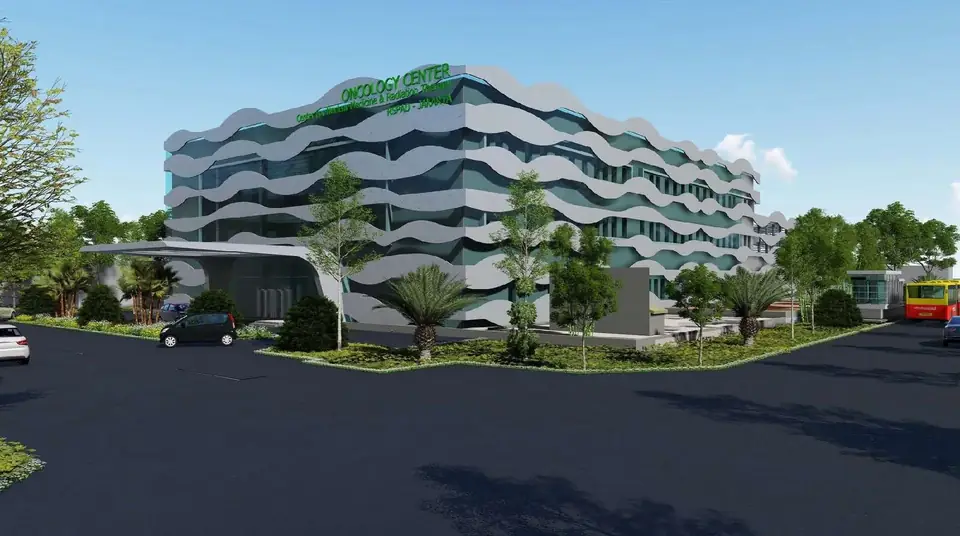
A radiation cancer treatment room is not built like an ordinary hospital room. Radiotherapy and proton therapy machines must sit inside a radiotherapy bunker: a room with thick concrete walls that keeps radiation from reaching the surrounding areas. This article explains what the bunker does, which Indonesian rules apply, and the structural challenges of casting thick concrete walls.
What does a radiotherapy bunker do?
Radiotherapy uses high-energy radiation beams to destroy cancer cells. That radiation has to stay inside the treatment room. The bunker's walls, floor and roof act as a shield that reduces radiation to a safe level for staff, other patients and people around the building.
Shielding design usually separates two kinds of barrier:
- Primary barriers: the parts of the wall, floor or roof that the main beam can hit directly.
- Secondary barriers: the other parts, which only receive scattered radiation and leakage from the machine.
A widely used international reference for photon radiotherapy is NCRP Report No. 151 on structural shielding design and evaluation for megavoltage X- and gamma-ray radiotherapy facilities. Shield thickness is set by medical physicists and designers based on the machine type, energy, workload and the use of surrounding spaces. That is why this article gives no wall thicknesses: the answer is different for every facility.
Proton therapy: from the Bragg peak to a more complex bunker
Proton therapy accelerates particles to close to the speed of light. Its advantage is the Bragg peak: proton energy is concentrated at a certain depth, so damage can be focused on the cancer while the dose to surrounding healthy tissue is reduced.
Proton therapy is still new in Indonesia. In June 2023 the Ministry of Health announced a partnership to develop proton therapy at Dharmais Cancer Hospital. In September 2025, BAPETEN and the IAEA held a national workshop on regulating proton therapy facilities, which covered room or bunker requirements and radiation shielding.
Structurally, proton facilities are usually more complex because the accelerator, beam line and treatment rooms work as one system. Room layout, openings and service routes have to be coordinated early with the equipment supplier and the radiation protection team.
BAPETEN rules that affect the building
Radiotherapy in Indonesia is regulated by BAPETEN Head Regulation No. 3 of 2013 on Radiation Safety in the Use of Radiotherapy. Several provisions relate directly to building design:
- A licence application includes drawings of the radiotherapy room at a scale of at least 1:50, including sections and the use of the surrounding spaces.
- A calculation of the radiation shielding thickness, with the material type and density, must be prepared.
- Shielding material needs a certificate to SNI or another traceable standard.
- The treatment room is a controlled area and must carry radiation signs and safety instructions.
For the structural team, points two and three matter most. The concrete density assumed in the shielding calculation must actually be achieved on site. Voids, honeycombing or poorly bonded construction joints can become weak points in the shield.
Tip: Bring the structural engineer, medical physicist and equipment supplier together at concept stage. Moving a machine or a door late in design can change wall thickness, foundation loads and service routes.
The structural challenge: casting mass concrete
Thick bunker walls and roofs are mass concrete. The American Concrete Institute (ACI) does not use a fixed size to define mass concrete. ACI describes it as any volume of concrete whose dimensions, restraint, mix and ambient conditions can lead to thermal stresses and cracking from the heat of cement hydration.
The problem is simple: cement gives off heat as it hardens. In a thick element the core stays hot while the surface cools faster, and the temperature difference can cause cracks. The ACI 301 specification cited by ACI limits the maximum concrete temperature after placing to 70 °C and the difference between core and surface to 19 °C.
Common control measures:
- Material choice, such as limiting cement content and using supplementary materials with lower heat of hydration.
- Pre-cooling and post-cooling, as set out in the construction plan.
- Pour management, including pour sequencing, temperature monitoring with sensors, and curing.
Other things to consider
Besides thermal cracking, radiotherapy bunkers bring other challenges:
- Very heavy loads. Thick concrete walls and roofs weigh far more than an ordinary room, so the foundations and slabs below need specific checks.
- Service penetrations. Pipes, ducts and cables through the walls must not become radiation leak paths.
- Doors and mazes. Access to the treatment room is usually designed so radiation does not travel straight to the door.
- Hospitals that stay open. Many bunkers are built in working hospitals, so vibration, noise and work sequence need planning.
Hospitals themselves are Risk Category IV buildings under SNI 1726: they must remain operational after an earthquake.
Project example: Proton Beam Therapy Building, RSPAD
Stadin engineered the structure of the Proton Beam Therapy Building, RSPAD in Jakarta. Our project records list 4 storeys and 1 basement with a floor area of 9,602 m², recorded in 2023. It is part of Stadin's hospital portfolio.
Conclusion
A radiotherapy bunker combines radiation protection, mass concrete and heavy structural loads. Shield thickness comes from a facility-specific calculation, and the concrete on site must match that calculation's assumptions. Every project needs calculation by a competent engineer working with a medical physicist. For hospitals and radiotherapy facilities, talk to Stadin about structural design.
This article provides general information. Every project still needs to be analysed and calculated by a competent structural or geotechnical engineer, in line with the applicable SNI codes and regulations.
Sources
- Peraturan Kepala BAPETEN Nomor 3 Tahun 2013 tentang Keselamatan Radiasi dalam Penggunaan Radioterapi
- What is mass concrete? (American Concrete Institute)
- Kemenkes Kembangkan Pengobatan Kanker Menggunakan Terapi Sinar Proton (Kementerian Kesehatan RI)
- National Workshop on Regulatory Control of Proton Beam Therapy Facilities (BAPETEN)